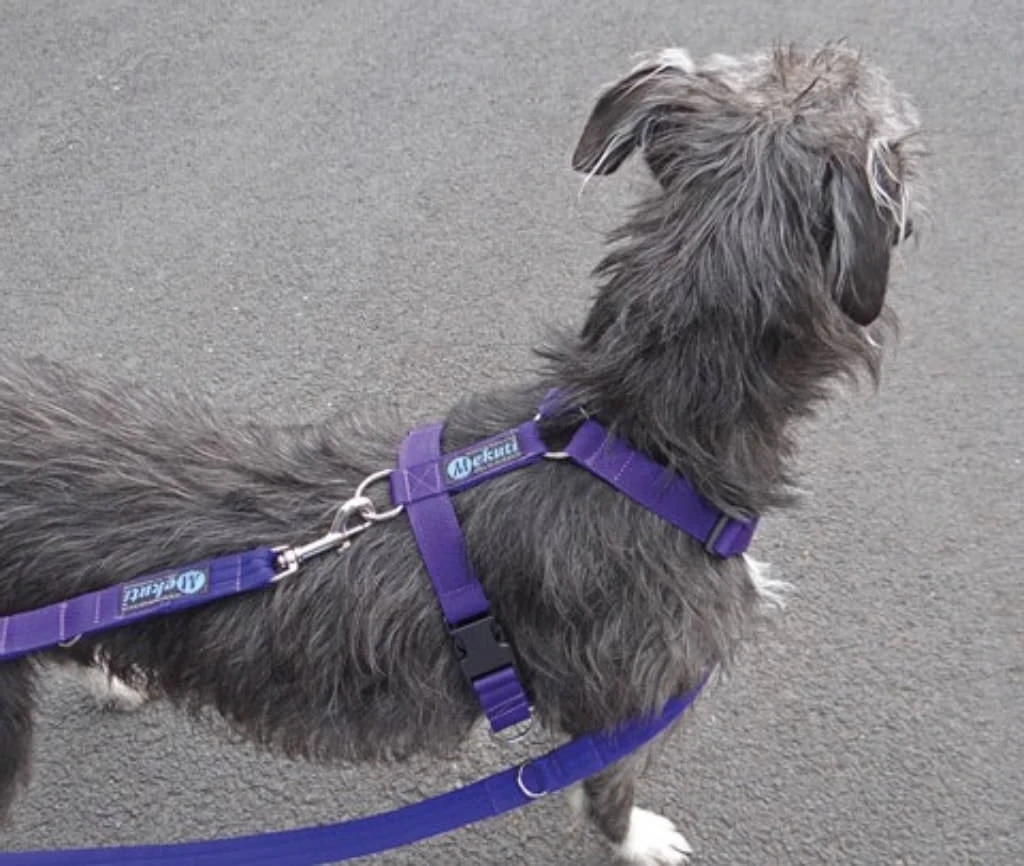
Mekuti Balance Harness & Lead Set
£33.29
The Mekuti Harness system is a positive and gentle way to help with dog walking. Dog walking should be joyful and not stressful,
In stock
1
Product Details
Mekuti:
Mekuti
Gentle way to stop dog pulling:
Gentle way to stop pulling
|
Options for FREE SHIPPING or FREE TRACKING UPGRADE on orders over £49 * |
"My dog pulls on the lead, my shoulders ache. Walking my dog is hard work and I don't enjoy walks any more. So, what can I do to stop my dog pulling on the lead?"
Mekuti Balance Harness with Double-Ended Lead uses the dog's response to gentle changes in its balance to help stop the dog pulling.
The handler uses the double-ended lead in a very gentle way to make this happen. We try to think of it as helping the dog walk nicely, rather than trying to stop the dog pulling.
The Mekuti Balance Harness system is a positive and gentle way to help with dog walking.
The method does not require the handler to be stronger than the dog because the more gentle and subtle the use of the lead, the better and more positive response from the dog. We are not engaging in a battle of wills or strength. We are being cooperative, kind, gentle, and going for a walk!
- - -
* For orders delivered to the UK
Some benefits
The Mekuti Balance Harness & Lead can help in the following ways
- Trainers find they can train their client's dogs easier
- Dog pulling is stopped or reduced on walks
- Easier to socialise with other dogs
- - -
- Puppies with growing bones and balanced muscle distribution
- Recovery during and after rehabilitation from surgery and hip dysplasia.
- Prevent and comfort hip and joint problems in young and older dogs
- Help with the handler's posture.
- Reduce aches and pains during dog walking.
- - -
- Let's Make Dog Walking Great Again!
It is important to note that the Mekuti Harness & Lead system does not replace the use of a qualified Dog Trainer, because it helps the trainer do the job of training and provide clients with better value for money and efficient time spent on other aspects of dog behaviour.
The Mekuti Balance Harness can be used together with a muzzle to help reduce anxiety and the worry of aggressive behaviours.
The Harness can also be put over a Dog Coat, Jumper or T-Shirt and used in the same way as usual.
Choosing the right size
Because putting and inspecting a tape measure around a dog can be stressful for the dog and produce wrong reading, it is easier to use a piece of tape/string or ribbon,
Circle it around the rib-cage, at least a couple of inches away from the front legs, (not too loose, not too tight, think of Goldilocks). Pinch the two ends between thumb and forefinger and measure the length in between.
| Harness Size | Harness & Lead Width (mm) |
Ribcage measurement (inches) |
Ribcage measurement (cm) |
| Mini* ** | 12 mm | 13" - 17" | 33 - 43 cm |
| Small | 19 mm | 17" - 23" | 43 - 59 cm |
| Medium | 19 mm | 20" - 30" | 50 - 76 cm |
| Large | 25 mm | 25" - 35" | 64 - 90 cm |
| XL ** |
25 mm | 30" - 46" | 76 - 115 cm |
* The Lead which is used with the Mini Harness is made from the same webbing material. All our other leads are made using a 'Softex' padded material.
** The Mini and XL sizes are only available in either Black or Red.
Where to measure?
Imagine the area where you might lift your dog with one hand and that will be the centre of mass or balance on your dog (please don't try and lift your dog this way, for obvious reasons). Ideally, that is where the side straps of the harness will be.
In practice, the harness often slips a bit further forwards of this point, but the closer it is to that area, the less effort is used to bring the dog's awareness to its balance. Always make sure the side straps are away from just behind the front legs (arm pits).
Lead Length: Standard or LONG 3m?
This depends upon the type of place you take your walks.
If you are by the roadside on a pavement most of the time then the standard length is probably best.
If you walk along country lanes using the LONG 3m lead will allow the dog a little more freedom to move around and have a sniff without having to follow it everywhere through puddles and mud etc.
Surely there is a mistake! Why are there are different 'standard' length leads?
To stop the handler stooping or leaning forwards, the Mini and Small Harness has a longer standard length lead because the distance between a small dog and handler if greater than with medium and larger dogs.
Will it suit my dog?
All the straps are adjustable and this harness is comfortable for small, large and medium size dogs. It can be used with all breeds, shapes, sizes and backgrounds: pedigree, crossbreeds and rescue dogs.
(Please note the Care Guidelines for Puppy owners below.)
The system can be used on very young pups, 'teenagers', adults and oldies where the gentle nature of how we guide users helps dogs which have aches, pains and whose senses are less acute. Diminished sight and hearing can increase anxiety so the physical support offered by the harness and lead going across the front can help, as can the feeling of being close and attached to the handler.
Reassurance is key for many dog and handler relationships. We cannot train or expect other dog walkers to give us space or account for us or our dog's foibles but we can creat our own safe space around ourselves by keeping calm and confident in all situations. The dog will respond to our own emotions so it is best to remain calm and avoid being angry during times of stress from our own or other people's dogs.
How do I choose colour?
Goodness knows! We've never seen a purple dog yet purple is a popular colour. Some go for fashion and style and others go for something less obvious.
Our colour range is fairly broad beyond the red and black in most sizes. While we have to remember that the Mekuti Balance Harness & Double-Ended Lead have a primarily functional use we try to offer as wide a range as we can.
Please also note that because the Mekuti Harnesses and Leads are made from different materials, the colours do not actually match, but they can be said to 'co-ordinate'!
How does it work?
Using the double-ended lead as guided, gives the dog the sensation of a gentle change in its balance position and it therefore makes and adjustment to its body position in response.
The Mekuti Balance Harness is purposefully designed to be lightweight to enable as little effort or tension on the lead to bring the dog's attention to its balance.
Constant tension in one direction creates constant resistance in the opposite direction, whether it comes from the dog or the handler -- this is dog pulling to us, and handler pulling to the dog!
INSTRUCTIONS: Tension, then Release
So, use the lead to make the contact with the dog (i.e. bring a small amount of tension to the lead) and then release it soon afterwards.
The dog will respond to its change in balance when the tension starts, and also when the tension is released. By making these contacts to the side or back of the harness, the dog keeps responding accordingly in equal and opposite directions. This is why the tension once applied is then released very soon afterwards, perhaps a second or two.
Repeat the manoeuvre after a few seconds, and keep changing the end of the lead being used, and the length of time the contact is being made. The dog should not be able to anticipate what is going to happen.
The contacts also help to draw the dog's attention from the usual attractive happenings, but still allow your dog to engage with its surroundings.
INSTRUCTIONS: Be really gentle
The more gentle and subtle the handler uses the lead to do this, the more more effective is the response. It is difficult to notice for an observer, which is why videos do not show it very well -- the contacts of tension are noticeable, then they are probably a bit too much.
Perhaps it is easier to think of the contact as creating pressure more than as bringing tension. The action with the lead is not a tug, jolt, pull, yank or jerk -- these will always indicate too much effort or force is being used.
Some simple psychology!
Well, it is not always to do any of the above if there is an excited and bouncy dog on the other end of the lead, so just keep things as gentle and supportive for the dog as possible.
Remember a bit of psychology: we all like to be allowed to do something, rather than be stopped from doing something. So, perhaps it is best to think of 'helping the dog walk nicely' rather than 'trying to stop the dog pulling'.
IMPORTANT: Care guidelines, especially PUPPIES!
We need to talk about The Puppy In The Room!
The harness is made from a webbing material and can be bitten through, particularly by young dogs with their sharp teeth. They can also bite through the lead fairly easily and almost unbelievably quickly. We have some picture which show some example of damage by teeth in our 'Rogues Gallery'.
Mekuti equipment is guaranteed for two years covering failure of the manufacturer's stitching, rings and trigger hooks.
NOTE: wear, breaking or snapping of the material, or damage to plastic attaching clips are not covered by guarantee.
Some dogs have harnesses that last years, but for some dogs, the equipment can only last a few months if the pulling behaviour continues and tension of the material on the rings on the harness continues, especially at the beginning of training. For instance, a 'first' harness may only last a few months but once they have become accustomed to the system, a 'second' harness can last for a number of years.
Particularly soon after purchasing, the harnesses and leads can appear to have broken or snapped. There is usually an 'innocent looking pup' close by which got curious. We understand this can be most frustrating, but Mekuti is not here to profit from people's misfortune, so do contact us for how we can help, though broken equipment cannot be replaced for free.
These things do not happen through an owner's neglect and there is no fault attached, but it is the sort of things that pups can do, even when we think they are being supervised, and 'never chew'.
How to get more life out of the equipment.
The Mekuti Balance Harness is easily washed and quickly dried, so they can conveniently washed regularly. Keeping the harness material clean will reduce wear over time, and keep the material softer and more comfortable for the dog.
The metal fixings can become corroded, especially when being used in salty conditions nearby the sea. For this reason it is more important to rinse and dry the harness after use. Hanging it up will help it dry out before the next trip out.
It is also useful to use a mineral oil on the metal fixings to keep them clean and offer some protection from damp and wet conditions. We recommend 'Ballistol Universal Oil' as it is food safe and more kind to animals than WD40, but something is better than nothing. A quick wipe every so often will help.
Remember, looking after the material and metalwork on your harness and lead will make them last years.
IMPORTANT: Safety guidelines
TRAVELLING
The Mekuti Harness IS NOT a 'car safety harness', and should not be attached to seat belts or straps to be used improvised as one.
The material and clips are not designed for this purpose and can lead to avoidable harm to the dog and other occupiers of a vehicle in the event of an accident or sudden stop.
However, a Mekuti Balance Harness Set is perfectly suitable for use on public transport. The harness should always be attached to the lead and the dog attended at all times. Special care should obviously be taken by roadsides and train station platforms when getting on and off.
The sensation a dog experiences when having the Mekuti Harness on with the Double-Ended Lead going across its front helps to make them feel more secure, comfortable and less anxious — it is a bit like a gentle hug.
Using a Mekuti Calming Band may also help when travelling in public spaces, especially when it is busy.
OFF LEAD
Your dog will still be able to run freely with a Mekuti harness on, without a lead. However, each dog is different and some take the opportunity to hide behind bushes and bite through it or manage to detatch it somehow. Not every dog that disappears with a harness on comes back with a harness on!
BEING LEFT UNATTENDED
Ideally, the dog should not be left unattended with a Mekuti Balance Harness on. Both the harness material and lead can be bitten through, so the equipment is not designed for be used for tethering or restraint. Always be in a position to observe your dog to see how they are responding to wearing the harness, and remove it if they seem irritated or uncomfortable. An indication of this might be the dog trying to get its mouth on the strap between the legs.
Save this product for later
Display prices in:
GBP